Hereditary Tyrosinaemia Type 1 (HT-1) is a condition where the body is unable to break down tyrosine, one of protein's essential building blocks. When the body cannot break down tyrosine, high levels build up in the blood and form a toxic substance known as succinylacetone.
What is Hereditary Tyrosinaemia Type 1 (HT-1)?
Hereditary Tyrosinaemia Type 1 (HT-1) is a rare, inherited metabolic disorder. People with this condition lack an enzyme needed to break down the amino acid tyrosine, an important building block of proteins1.As the body cannot break down tyrosine, high levels build up in the blood and urine and form a toxic substance called succinyl acetone2. High volumes of tyrosine and its metabolites in the liver can result in severe liver disease. Tyrosine may also accumulate in the kidneys and central nervous system3. This means that if tyrosinaemia isn't treated, it may cause liver and kidney damage, neurological issues, and reduced life expectancy.
How common is HT-1?
1 in 100,000
The condition is extremely rare, about one person in every 100,000 worldwide will be born with the most severe form of HT-1

HT-1 appears more frequently in some regions, including the Saguenay-Lac-Saint-Jean region in Quebec, Canada, and also Norway and Finland.4

If left untreated, people born with HT-1 develop severe liver failure and have a life expectancy of around two years.5
*Today, with early detection and diagnosis and the development of long-term medication treatment, life expectancy has been increased for people with HT-1. 6
What are the symptoms of HT-1?
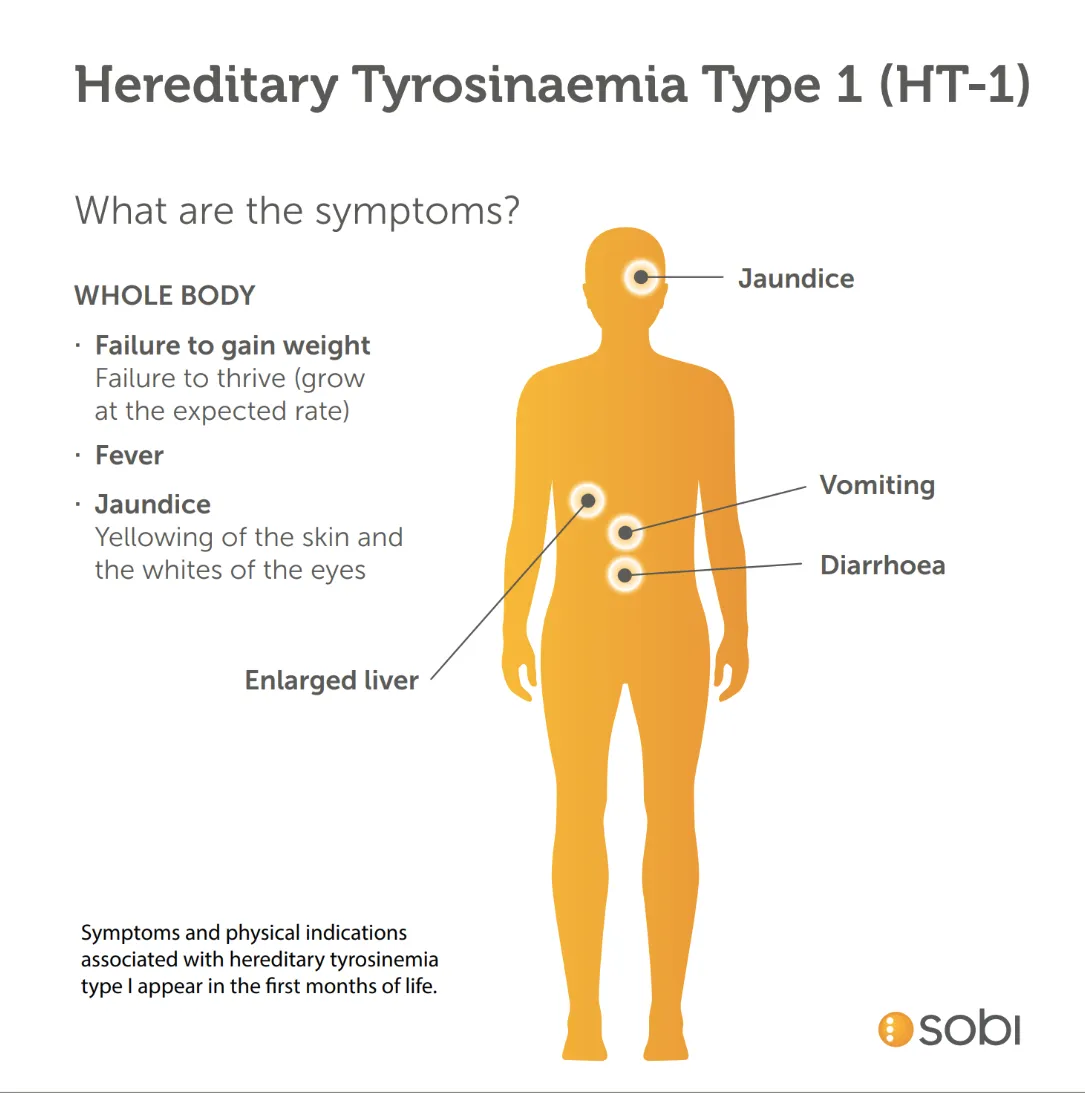
Symptoms and physical indications associated with hereditary tyrosinemia type I appear in the first months of life.
Symptoms include:
- Failure to gain weight and grow at the expected rate (failure to thrive)
- Fever
- Diarrhoea
- Vomiting
- An abnormally enlarged liver (hepatomegaly)
- Jaundice (yellowing of the skin and the whites of the eyes)7
What treatments are available for HT-1?
- HT-1 is treated with a specific medication that prevents the build-up of toxic breakdown products alongside a low-tyrosine diet.10,11
- These treatments are not cures, but lessen the effects of HT-1.12 If left untreated, the condition may progress to serious complications including severe liver disease, cirrhosis, and hepatocarcinoma, the most common type of primary liver cancer.13,14
- The only way to correct the metabolism of tyrosine is to have a liver transplant, but this is rare and mostly unnecessary as most children respond well to the medication and diet approach.15
How is HT-1 diagnosed?
Hereditary Tyrosinaemia Type 1 is diagnosed by blood, urine, or molecular testing which detects high levels of succinyl acetone.8,9
Specialty Care
Specialty Care focuses on rare genetic and metabolic diseases, as well as select complex conditions across immunology and haematology.
References
1Myriad Genetics: Tyrosinemia Type I
https://myriad.com/womens-health/diseases/tyrosinemia-type-i/
2Science Direct: Inborn Errors of Metabolism with Hepatopathy: Metabolism Defects of Galactose, Fructose, and Tyrosine
https://www.sciencedirect.com/science/article/abs/pii/S0031395517301839
3National Organization for Rare Diseases: Tyrosinemia Type 1
https://rarediseases.org/rare-diseases/tyrosinemia-type-1/
4National Center for Biotechnology Information: Hypertyrosinemia
https://www.ncbi.nlm.nih.gov/books/NBK578205/
5National Center for Biotechnology Information: Hypertyrosinemia
https://www.ncbi.nlm.nih.gov/books/NBK578205/
6The Lancet: Long-term safety and outcomes in hereditary tyrosinaemia type 1 with nitisinone treatment: a 15-year non-interventional, multicentre study
https://www.thelancet.com/journals/landia/article/PIIS2213-8587(21)00092-9/abstract (NOTE: research funding from Sobi)
7National Organization for Rare Diseases: Tyrosinemia Type 1
https://rarediseases.org/rare-diseases/tyrosinemia-type-1/
8Galen Medical Nutrition: Tyrosinemia Type 1
https://galenmedicalnutrition.com/metabolics/tyrosinemia-type-one/#:~:text=HT1%20is%20diagnosed%20by%20high,and%20urine%2C%20and%20molecular%20testing.
9UMass Chan Medical School: What is Hereditary Tyrosinemia Type 1?
https://www.umassmed.edu/rare-disease-research/research-diseases-and-conditions/hereditary-yrosinemia-type-1/#:~:text=Research%20Strategies,HTI%2C%20they%20are%20not%20curative.
10UMass Chan Medical School: What is Hereditary Tyrosinemia Type 1?
https://www.umassmed.edu/rare-disease-research/research-diseases-and-conditions/hereditary-yrosinemia-type-1/#:~:text=Research%20Strategies,HTI%2C%20they%20are%20not%20curative.
11Children’s Hospital of Pittsburgh: Tyrosinemia Treatment and Symptoms
https://www.chp.edu/our-services/transplant/liver/education/liver-disease-states/tyrosinemia#:~:text=The%20treatment%20for%20tyrosinemia%20is,and%20beans%20should%20be%20avoided.
12UMass Chan Medical School: What is Hereditary Tyrosinemia Type 1?
https://www.umassmed.edu/rare-disease-research/research-diseases-and-conditions/hereditary-yrosinemia-type-1/#:~:text=Research%20Strategies,HTI%2C%20they%20are%20not%20curative.
13National Organization for Rare Diseases: Tyrosinemia Type 1
https://rarediseases.org/rare-diseases/tyrosinemia-type-1/
14Mayo Clinic: Hepatocellular carcinoma
https://www.mayoclinic.org/diseases-conditions/hepatocellular-carcinoma/cdc-20354552#:~:text=Hepatocellular%20carcinoma%20(HCC)%20is%20the,B%20or%20hepatitis%20C%20infection
15Children’s Hospital of Pittsburgh: Tyrosinemia Treatment and Symptoms
https://www.chp.edu/our-services/transplant/liver/education/liver-disease-states/tyrosinemia#:~:text=The%20treatment%20for%20tyrosinemia%20is,and%20beans%20should%20be%20avoided.
Jun, 2026