Familial Chylomicronaemia Syndrome (FCS) is an ultra-rare disease which causes extremely high levels of triglycerides in the blood, which are a type of fat that come from food.
What is Familial Chylomicronemia Syndrome (FCS)?
Familial Chylomicronaemia Syndrome (FCS) is an ultra-rare genetic condition that stops the body from breaking down fats consumed through food.1 These fats are called triglycerides. People with FCS are missing the enzyme lipoprotein lipase which clears triglycerides from the blood after eating.2 These fats are carried in the blood by large structures called chylomicrons and they help move triglycerides around the body where they are needed for energy and fat storage.3
People with FCS have a range of symptoms, and the long-term effects are usually pancreatitis and diabetes.4FCS is also known as familial hyperchylomicronaemia syndrome,5 lipoprotein lipase deficiency (LPLD), Fredrickson Type 1 hyperlipoproteinemia, or familial hypertriglyceridemia.6
How common is FCS?
1 to 2 in 1,000 000
FCS is very rare, with only around one or two people in a million living with the condition.7

Globally, FCS can affect people of any age, ethnicity or gender.8

Living with FCS can affect a person’s quality of life.*
*Living with FCS can affect a person’s quality of life and many of the symptoms of FCS cause psychosocial and clinical stress for those living with FCS and their families.9 The most common complication of FCS is acute and regular pancreatitis and hospitalisation. Acute severe pancreatitis can cause multi-organ failure and increases morbidity and mortality.10
What are the symptoms of Familial Chylomicronemia Syndrome (FCS)?
People with FCS often have daily symptoms including abdominal pain, general fatigue, and impaired condition.
Common symptoms include:
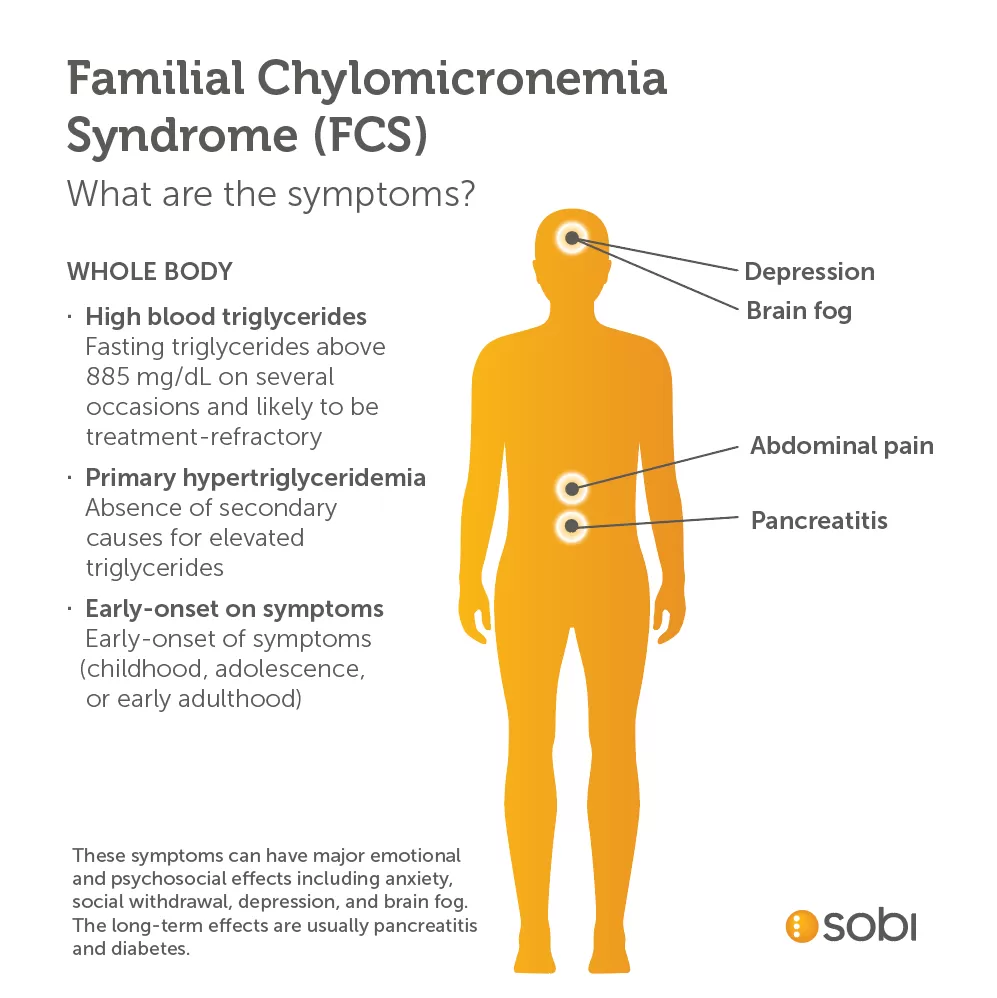
- Frequent episodes of acute pancreatitis
- Recurrent bouts of abdominal pain
- Fatty deposits in the skin (eruptive xanthomas)
- Enlarged liver and spleen due to fat buildup
- Very high levels of a type of fat called triglyceride in the blood
- Absence of secondary causes for elevated triglycerides
- Early-onset of symptoms (childhood, adolescence, or early adulthood) 12,13,14
These symptoms can have major emotional and psychosocial effects including anxiety, social withdrawal, depression, and brain fog.15 The long-term effects are usually pancreatitis and diabetes.16
How is FCS diagnosed?
To diagnose FCS, medical practitioners will assess clinical signs and symptoms and use diagnostic testing to identify extreme elevations in triglyceride levels.17,18
Genetic testing is commonly used to confirm the diagnosis.19
What treatments are available for FCS?
There is currently no cure for FCS. A very-low-fat diet remains an important part of managing the condition. In some countries, prescription medicines are also approved for certain adults with FCS and are used alongside diet. Approval and access vary by country, and a specialist can advise on options appropriate for each person.20
Lifestyle and FCS symptoms
Management of FCS may include lifestyle measures as well as other treatment options recommended by a healthcare professional. Lifestyle measures include:
- Avoiding alcohol
- Eating a fat-free diet
- Limiting sugar intake and simple carbohydrates (these are found in fruit, sweets/candy, sugary fizzy/soda drinks)
- Avoiding medications that increase triglyceride levels (diuretics, steroids, oestrogens, high blood pressure medications, immune system suppressors, antidepressants, some heart medications, and fish oil supplements)
- Eating a healthy diet
- Eating small, frequent meals
- Taking supplements, and minerals and medium chain triglycerides (as advised by a medical practitioner)21
Managing FCS usually includes an interprofessional team, including an endocrinologist or lipidologist, dietician, patient’s support group, and primary care.22
Related link for HCPs
Explore the following resource to learn more about Familial Chylomicronemia Syndrome:
Specialty Care
We provide therapies for rare genetic and metabolic diseases as well as a number of specialist indications.
References
1Endocrine Society: Familial Chylomicronemia Syndrome
https://www.endocrine.org/patient-engagement/endocrine-library/familial-chylomicronemia-syndrome
2Heart UK: Familial chylomicronaemia syndrome (FCS)
https://www.heartuk.org.uk/fcs/familial-chylomicronaemia-syndrome-fcs
3Endocrine Society: Familial Chylomicronemia Syndrome
https://www.endocrine.org/patient-engagement/endocrine-library/familial-chylomicronemia-syndrome
4Heart UK: Familial chylomicronaemia syndrome (FCS)
https://www.heartuk.org.uk/fcs/familial-chylomicronaemia-syndrome-fcs
5National Center for Biotechnology Information: Familial Hyperchylomicronemia Syndrome
https://www.ncbi.nlm.nih.gov/books/NBK551655/
6Loma Linda University Health: Familial Chylomicronemia Syndrome (FCS)
https://lluh.org/conditions/familial-chylomicronemia-syndrome-fcs#:~:text=It%20is%20a%20hereditary%2C%20serious,know%20how%20to%20diagnose%20it.
7Orphanet Journal of Rare Diseases: Symptoms and impacts of familial chylomicronemia syndrome: a qualitative study of the patient experience
https://ojrd.biomedcentral.com/articles/10.1186/s13023-023-02927-8#:~:text=Introduction-,Familial%20chylomicronemia%20syndrome%20(FCS)%20is%20a%20rare%2C%20hereditary%2C,1%2C000%2C000%20%5B1%2C%202%5D.
8The National Pancreas Foundation: Familial Chylomicronemia Syndrome (FCS)
https://pancreasfoundation.org/pancreas-disease/fcs/
9The National Pancreas Foundation: Familial Chylomicronemia Syndrome (FCS)
https://pancreasfoundation.org/pancreas-disease/fcs/
10National Center for Biotechnology Information: Familial Hyperchylomicronemia Syndrome
https://www.ncbi.nlm.nih.gov/books/NBK551655/
11Endocrine Society: Familial Chylomicronemia Syndrome
https://www.endocrine.org/patient-engagement/endocrine-library/familial-chylomicronemia-syndrome#:~:text=FCS%20is%20diagnosed%20by%20a,Recurrent%20bouts%20of%20abdominal%20pain
12Endocrine Society: Familial Chylomicronemia Syndrome
https://www.endocrine.org/patient-engagement/endocrine-library/familial-chylomicronemia-syndrome
13The National Pancreas Foundation
https://pancreasfoundation.org/pancreas-disease/fcs/
14National Organization for Rare Diseases
https://rarediseases.org/rare-diseases/familial-chylomicronemia-syndrome/
15Heart UK: Familial chylomicronaemia syndrome (FCS)
https://www.heartuk.org.uk/fcs/familial-chylomicronaemia-syndrome-fcs
16Heart UK: Familial chylomicronaemia syndrome (FCS)
https://www.heartuk.org.uk/fcs/familial-chylomicronaemia-syndrome-fcs
17Journal of Clinical Lipidology
https://www.lipidjournal.com/article/S1933-2874(25)00066-2/fulltext
18Endocrine Society: Familial Chylomicronemia Syndrome
https://www.endocrine.org/patient-engagement/endocrine-library/familial-chylomicronemia-syndrome
19Moulin P, Dufour R, Averna M, et al. Identification and diagnosis of patients with familial chylomicronaemia syndrome (FCS): Expert panel recommendations and proposal of an "FCS score". Atherosclerosis. 2018;275:265-272. doi:10.1016/j.atherosclerosis.2018.06.814
20Medline Plus: Familial lipoprotein lipase deficiency https://medlineplus.gov/ency/article/000408.htm#:~:text=Familial%20lipoprotein%20lipase%20deficiency%20is%20caused%20by%20a%20defective%20gene,build%20up%20in%20the%20blood.
21Loma Linda University Health: Familial Chylomicronemia Syndrome (FCS)
https://lluh.org/conditions/familial-chylomicronemia-syndrome-fcs#:~:text=To%20manage%20FCS%2C%20doctors%20tell,in%20fruit%2C%20sodas%20or%20candy)
22National Center for Biotechnology Information: Familial Hyperchylomicronemia Syndrome
https://www.ncbi.nlm.nih.gov/books/NBK551655/
Jun, 2026