Hereditary transthyretin amyloidosis (hATTR) is a rare, progressive and debilitating genetic disease caused by a gene change or mutation in the transthyretin (TTR) protein. It is a type of amyloidosis, a group of four diseases with various causes and symptoms.
What is hereditary transthyretin amyloidosis (hATTR)?
Hereditary Transthyretin (hATTR) Amyloidosis is a rare, inherited genetic condition caused by an abnormal or altered transthyretin (TTR) gene.
If someone has hATTR, they will have a build-up of abnormal proteins called amyloid in one or more organs and nerves which impairs the organ function.1 The most common parts of the body affected by symptoms are the nerves, heart, kidney, and eyes.2A genetic test is the only way to see if a person has the gene that increases the risk of developing hATTR.3
How common is hereditary transthyretin amyloidosis (hATTR)?
People of all races and ethnicities can have hATTR but it is more common in people of West African, Irish, or Portuguese ancestry. The diagnosis rates in Sweden and Japan are greater than expected.5 The life expectancy for someone diagnosed with hATTR depends on the specific gene mutation and the person’s age when they are first diagnosed.6 For people diagnosed with hATTR, only around half survive past 4.7 years post-diagnosis.7 However, research is helping to identify and develop new treatments.8
50,000
Around the world, only around 50,000 have been diagnosed with hATTR, but the real number might be higher.4

Globally, people of all races and ethnicities can have hATTR.

Life expectancy in hATTR varies by mutation and age at diagnosis.
What are the symptoms of hATTR?
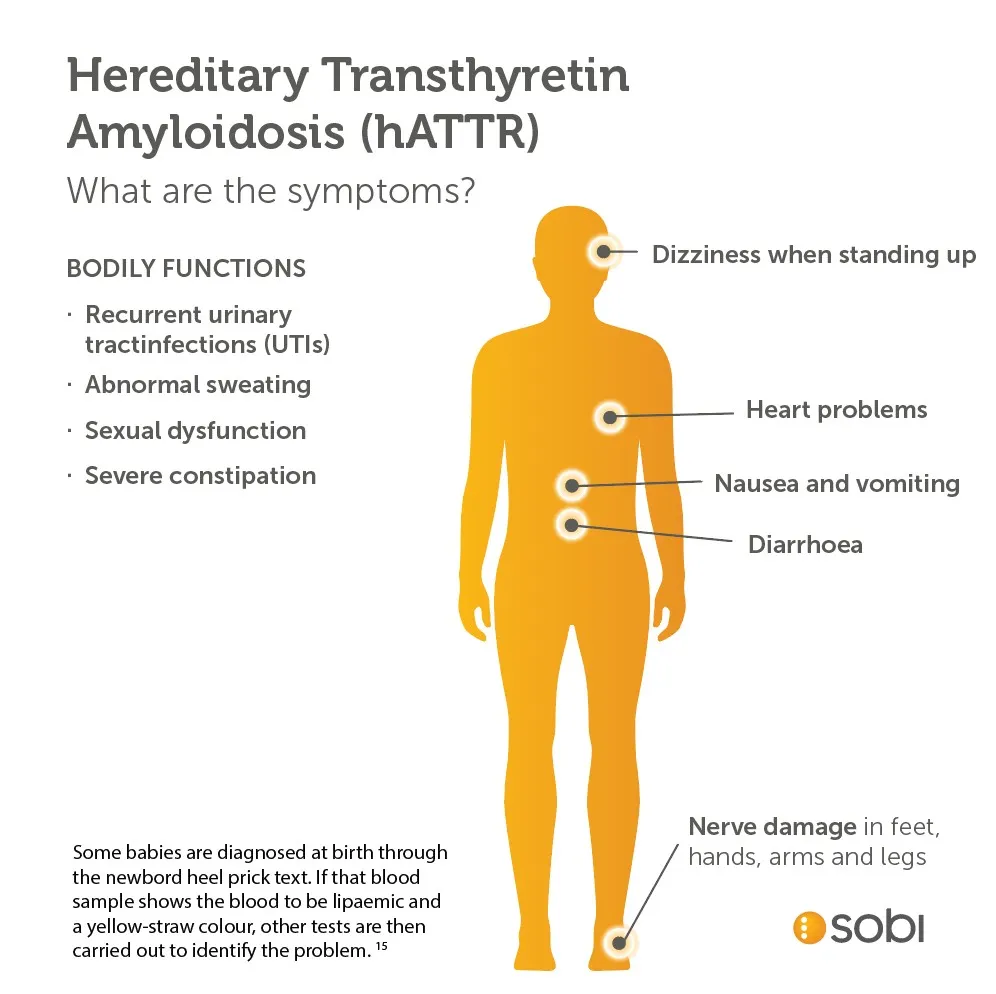
Although people are born with hATTR, there are 150 different known mutations that cause the condition.9 For most people, symptoms don’t appear until later in life, but in some cases symptoms start in early adulthood.10 Some babies are diagnosed at birth through the newborn heel prick text. If the blood sample shows the blood to be lipaemic and a yellow-straw colour, other tests are done to identify the problem.11
Understanding family and genetic history will help to understand when and how symptoms will start.12 Even within families, symptoms may differ and affect different parts of the body including:13
Bodily symptoms
- Recurrent urinary tract infections (UTIs)
- Abnormal sweating
- Dizziness when standing up
- Sexual dysfunction
- Nausea and vomiting
- Diarrhoea
- Severe constipation
- Unintentional weight loss
Heart
- Fatigue
- Dizziness
- Shortness of breath
- Leg swelling (edema)
Nerves in hands, feet, arms and legs
- Tingling
- Numbness
- Carpal tunnel syndrome
- Burning pain
- Loss of sensitivity to temperature
- Loss of movement control
- Weakness
Other Symptoms
- Glaucoma
- Blurred or spotty vision
- Floaters in the eye
- Worsening dementia
- Stroke-like episodes
- Kidney dysfunction
How is hATTR diagnosed?
For doctors to identify hATTR they have to look for the underlying causes of symptoms.14 There are several diagnostic tests that can show if a patient has hATTR. These include:
- Genetic testing
- Biopsy
- Blood test
- Urine test
- Bone Scan
- Cardiac imaging
- Nerve conduction
- Eye exam15
What treatments are available for hATTR?
Unfortunately, there is no cure for hATTR but specific medications and treatment approaches can help alleviate symptoms and slow down progression.16
If hATTR is not treated, it can cause life-threatening complications.17
Specialty Care
Specialty Care focuses on rare genetic and metabolic diseases, as well as select complex conditions across immunology and haematology.
Therapeutic areas
Our therapies are concentrated within the areas of haematology, immunology, and specialty care.
References
1 Amyloidosis Research Consortium: Disease Overview, Hereditary Transthyretin Amyloidosis
https://arci.org/wp-content/uploads/2021/03/Disease-Overview_hATTR.pdf
2 Amyloidosis UK
https://amyloidosisuk.org/hereditary-amyloidosis/
3 Amyloidosis UK: Hereditary amyloidosis
https://amyloidosisuk.org/hereditary-amyloidosis/
4 PTC Therapeutics https://www.ptcbio.com/therapeutic-areas/hereditary-transthyretin-amyloidosis/#:~:text=There%20are%20about%2050%2C000%20people%20with%20hATTR%2DPN%20worldwide1.
5 American Heart Association: What is hATTR amyloidosis?
https://www.heart.org/-/media/Files/Health-Topics/Answers-by-Heart/What-is-hATTR-Amyloidosis.pdf
6 My Amyloidosis Team: What’s the Life Expectancy With hATTR Amyloidosis?
https://www.myamyloidosisteam.com/resources/whats-the-life-expectancy-with-hattr-amyloidosis
7 My Amyloidosis Team: What’s the Life Expectancy With hATTR Amyloidosis?
https://www.myamyloidosisteam.com/resources/whats-the-life-expectancy-with-hattr-amyloidosis
8 My Amyloidosis Team: What’s the Life Expectancy With hATTR Amyloidosis?
https://www.myamyloidosisteam.com/resources/whats-the-life-expectancy-with-hattr-amyloidosis
9 Amyloidosis UK: Hereditary amyloidosis
https://amyloidosisuk.org/hereditary-amyloidosis/
10 Amyloidosis Research Consortium: Disease Overview, Hereditary Transthyretin Amyloidosis
https://arci.org/wp-content/uploads/2021/03/Disease-Overview_hATTR.pdf
11 Amyloidosis UK: Treatment
https://amyloidosisuk.org/treatment/
12 Amyloidosis UK: Hereditary amyloidosis
https://amyloidosisuk.org/hereditary-amyloidosis/
13 The Bridge - hATTR amyloidosis: What are the symptoms of hATTR amyloidosis?
https://www.hattrbridge.com/about-hattr-amyloidosis/symptoms
14 National Center for Biotechnology Information: Diagnosis and Screening of Patients with Hereditary Transthyretin Amyloidosis (hATTR): Current Strategies and Guidelines
https://www.ncbi.nlm.nih.gov/pmc/articles/PMC7434568/
15 American Heart Association: What is hATTR amyloidosis?
https://www.heart.org/-/media/Files/Health-Topics/Answers-by-Heart/What-is-hATTR-Amyloidosis.pdf
16 Rare Disease Advisor: Expert Consensus on Diagnosing and Treating hATTR With Polyneuropathy
https://www.rarediseaseadvisor.com/news/diagnosing-treating-hattr-amyloidosis-polyneuropathy/
17 Amyloidosis Research Consortium: Disease Overview, Hereditary Transthyretin Amyloidosis
https://arci.org/wp-content/uploads/2021/03/Disease-Overview_hATTR.pdf
Jun, 2026